> ## Documentation Index
> Fetch the complete documentation index at: https://docs.linkutm.com/llms.txt
> Use this file to discover all available pages before exploring further.
# Link scheduling
> Control when a link becomes active, when it stops, and where it sends visitors after it expires.
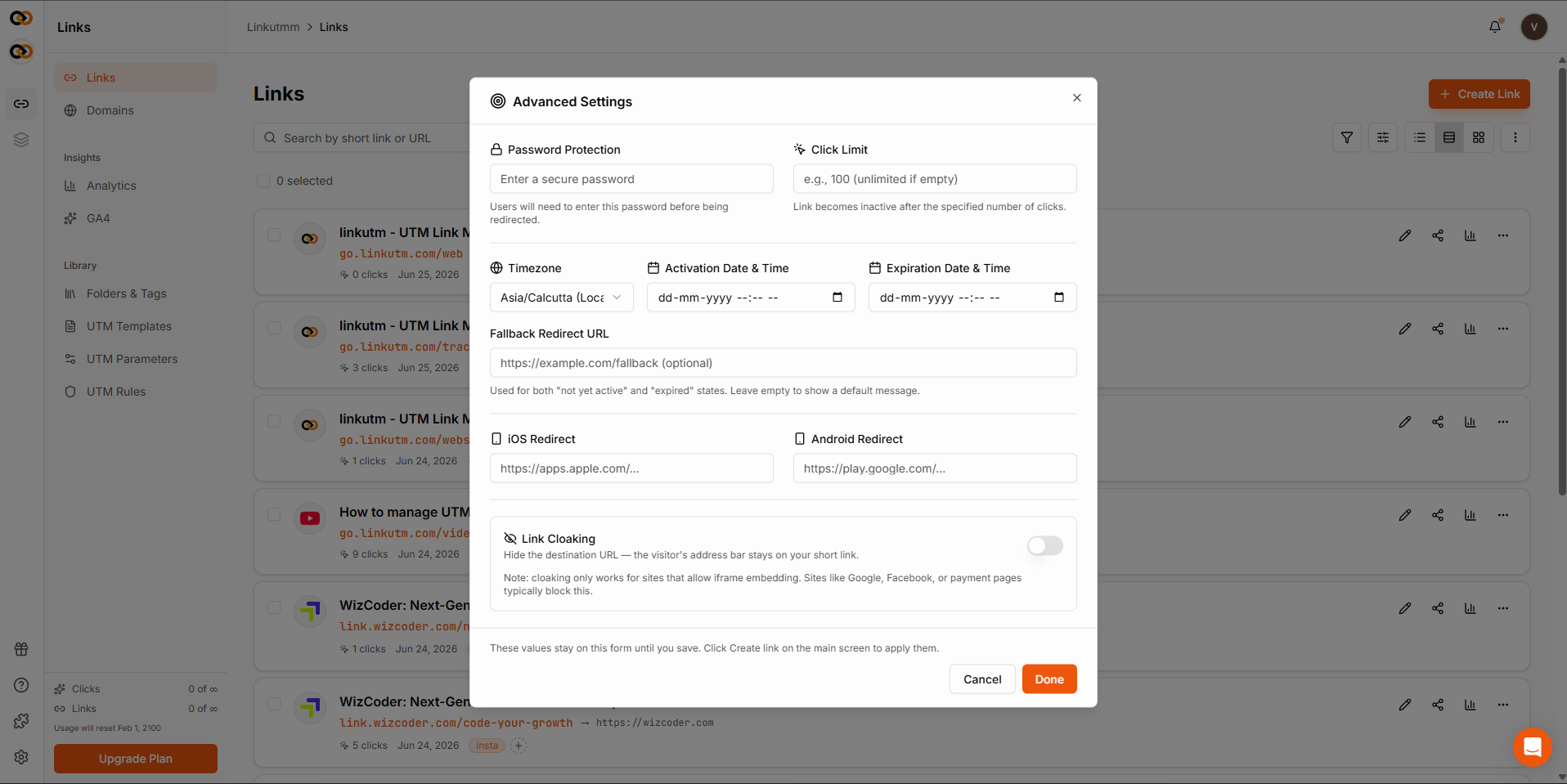
Two date controls let you define the active window for a link:
* **Activation Date & Time**: the link does not redirect to its destination until this moment. Before then, visitors go to the fallback URL if one is set, otherwise they see a "not found" response.
* **Expiration Date & Time**: after this moment, the link stops sending visitors to the destination. They go to the fallback URL if one is set, otherwise they see a "not found" response.
* **Fallback URL**: an alternate destination the link redirects to once it has expired, or if someone clicks the link before the activation date.
* **Click limit**: a maximum number of clicks. Once hit, the link stops redirecting.
You can set any combination of these. A link with only an activation date goes live on schedule and stays live forever. A link with only an expiration date is live immediately and cuts off at the set time.
## When to use it
* Pre-building campaign links days in advance and scheduling them to go live at a precise moment.
* Running a limited-time promotion that starts and ends automatically with no manual intervention.
* Setting a hard cutoff on a flash sale or embargoed announcement.
* Capping a giveaway link at a specific number of clicks.
* Sending visitors somewhere useful (a waitlist, a homepage) after a campaign ends.
## How to use it
In the create or edit link panel, click **Advanced** in the bottom bar.
Select your timezone from the dropdown. linkutm defaults to your browser's detected timezone. All dates and times you enter are interpreted in this timezone.
Fill in **Activation Date & Time** if you want the link to start at a future moment. Leave blank for the link to go live immediately on save.
Fill in **Expiration Date & Time** if you want the link to stop at a set moment. If an activation date is also set, expiration must be later than activation.
Type a number in **Click Limit**. The counter increments on each real visit. Once the limit is reached, the link stops redirecting.
Enter a **Fallback Redirect URL**. After the link expires (by date or click limit), or if someone clicks before the activation date, visitors are sent here instead of seeing a "not found" page.
The schedule is stored. The link activates, expires, and redirects to fallback on its own.
 ## Real-world example
A Black Friday flash sale running for 48 hours, capped at 500 clicks, with a fallback to the main store:
```
Destination: https://acme.com/bf-50-off
Activation: 2025-11-28 00:00 (New York / ET)
Expiration: 2025-11-29 23:59 (New York / ET)
Click limit: 500
Fallback URL: https://acme.com/shop
utm_source: email
utm_campaign: bf_flash_2025
```
Before November 28 midnight ET, the link isn't active yet, so visitors are sent to the fallback `acme.com/shop`. After November 29 at midnight ET, or after 500 clicks (whichever comes first), the link expires and visitors are again sent to `acme.com/shop`. In between, the link serves its destination.
## Common mistakes
If the expiration date is the same as or earlier than the activation date, the link never becomes active. The builder blocks this and shows a validation error. Check that expiration is set to a later time than activation.
The timezone picker defaults to your browser timezone. If you're scheduling for a different region, switch the timezone first. Otherwise your go-live moment will be off.
Clicks can spike fast. A limit of 100 on a link that suddenly gets 50,000 impressions cuts off almost everyone. Set the limit only when a hard cap is the actual intent.
Past clicks stay in analytics. Expiration only stops new redirects.
## Edge cases
**Activation and expiration are both optional.** Set one, both, or neither. A link with no activation date goes live on save. A link with no expiration date stays live indefinitely.
**Click limit vs. expiration.** Both stop the link when triggered. If both are set, whichever condition is hit first stops the link. The fallback URL applies in both cases.
**Existing links.** You can add or change a schedule on a link that is already live. Setting an activation date in the past is treated as already active.
**UTM parameters do not carry to the fallback URL.** The fallback URL is used exactly as entered, whether the visitor arrives before activation, after expiration, or after the click limit is hit. If you need tracking on fallback traffic, add UTM parameters directly to the fallback URL.
## Real-world example
A Black Friday flash sale running for 48 hours, capped at 500 clicks, with a fallback to the main store:
```
Destination: https://acme.com/bf-50-off
Activation: 2025-11-28 00:00 (New York / ET)
Expiration: 2025-11-29 23:59 (New York / ET)
Click limit: 500
Fallback URL: https://acme.com/shop
utm_source: email
utm_campaign: bf_flash_2025
```
Before November 28 midnight ET, the link isn't active yet, so visitors are sent to the fallback `acme.com/shop`. After November 29 at midnight ET, or after 500 clicks (whichever comes first), the link expires and visitors are again sent to `acme.com/shop`. In between, the link serves its destination.
## Common mistakes
If the expiration date is the same as or earlier than the activation date, the link never becomes active. The builder blocks this and shows a validation error. Check that expiration is set to a later time than activation.
The timezone picker defaults to your browser timezone. If you're scheduling for a different region, switch the timezone first. Otherwise your go-live moment will be off.
Clicks can spike fast. A limit of 100 on a link that suddenly gets 50,000 impressions cuts off almost everyone. Set the limit only when a hard cap is the actual intent.
Past clicks stay in analytics. Expiration only stops new redirects.
## Edge cases
**Activation and expiration are both optional.** Set one, both, or neither. A link with no activation date goes live on save. A link with no expiration date stays live indefinitely.
**Click limit vs. expiration.** Both stop the link when triggered. If both are set, whichever condition is hit first stops the link. The fallback URL applies in both cases.
**Existing links.** You can add or change a schedule on a link that is already live. Setting an activation date in the past is treated as already active.
**UTM parameters do not carry to the fallback URL.** The fallback URL is used exactly as entered, whether the visitor arrives before activation, after expiration, or after the click limit is hit. If you need tracking on fallback traffic, add UTM parameters directly to the fallback URL.