

When to use it
Every link. UTMs are how Google Analytics, Mixpanel, Amplitude, and most attribution tools tell campaigns apart.The five fields
Which initiative this belongs to.
Examples:
q2-launch, black-friday-2025, weekly-digest.Where the click came from. Treat as a “platform name.”
Examples:
google, facebook, newsletter, partner-blog.How the click was delivered. The “channel type.”
Examples:
cpc, email, social, display, affiliate.Optional. Paid search keyword or audience segment.
Examples:
running-shoes, lookalike-us.Optional. Differentiator for A/B variants or creative pieces.
Examples:
headline-a, carousel-3, cta-orange.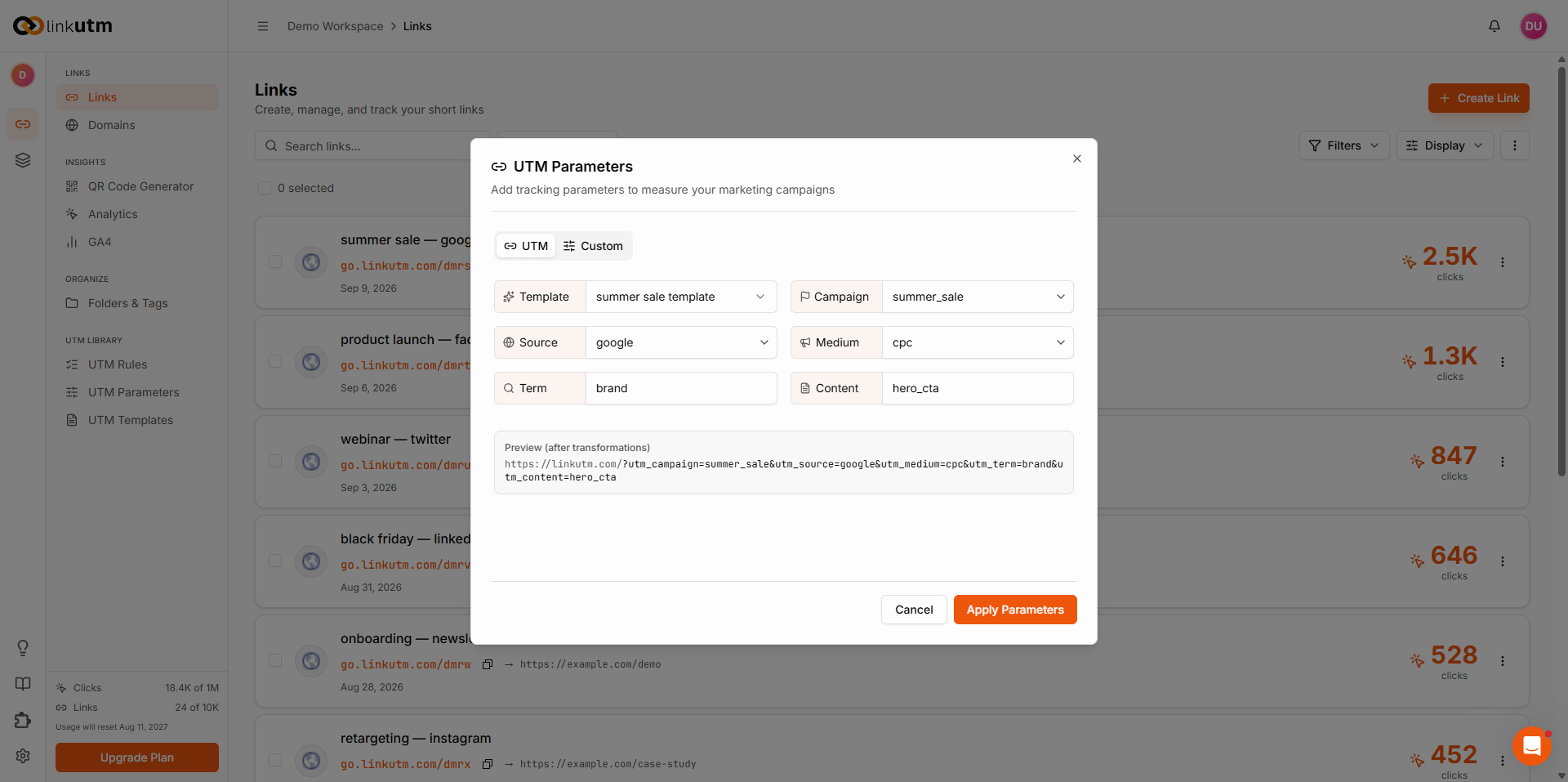
How it works
When you save a link, the entered values pass through your workspace’s UTM Rules in this order:1
Force lowercase
Summer-Sale → summer-sale (default ON).2
Space replacement
summer sale → summer_sale using your configured space character (default _).3
Max length
Truncated/rejected if over the workspace limit (default 100).
4
Prohibited terms
Hard fail if value contains any banned term you set (“test”, “draft”, etc).
5
Allowed characters
Hard fail if value contains characters outside the set you allow (lowercase, numbers, dots, hyphens). Skipped if you haven’t restricted any.
Custom UTM parameters
Beyond the five standards, you can attach additional custom parameters to a link. Add a name and value in the Custom UTM Parameters section, and they are appended to every redirect as extra URL parameters. For example, addingaudience = lookalike-3 appends &utm_audience=lookalike-3 to the destination URL.
Real-world examples
- Google Ads
- Meta Ads
- Email
- Influencer / partner
Common mistakes
Source vs medium swapped
Source vs medium swapped
source=email, medium=newsletter is wrong. Source = platform name; medium = channel type. Right: source=newsletter, medium=email.Free-form campaign names
Free-form campaign names
Q2 Launch !!, q2 launch, Q2_Launch become different rows in GA without rules. Use a template per campaign.Using utm_term for non-search
Using utm_term for non-search
utm_term is conventionally paid-search keyword. For audience segments use utm_content or a custom UTM.PII in UTMs
PII in UTMs
UTMs land in your destination URL and analytics. Don’t include emails, names, anything personally identifiable.
Edge cases
UTMs already on the destination URL are preserved. linkutm appends its UTMs alongside them; if there’s a key collision, linkutm’s value wins.