

utm_content and utm_term to appear in GA4 reports.
linkutm’s Pixel Tracking integration fires a GA4 PageView event on the short link click itself (at the redirect page). UTM attribution covers the destination page session. These are complementary, not the same thing.
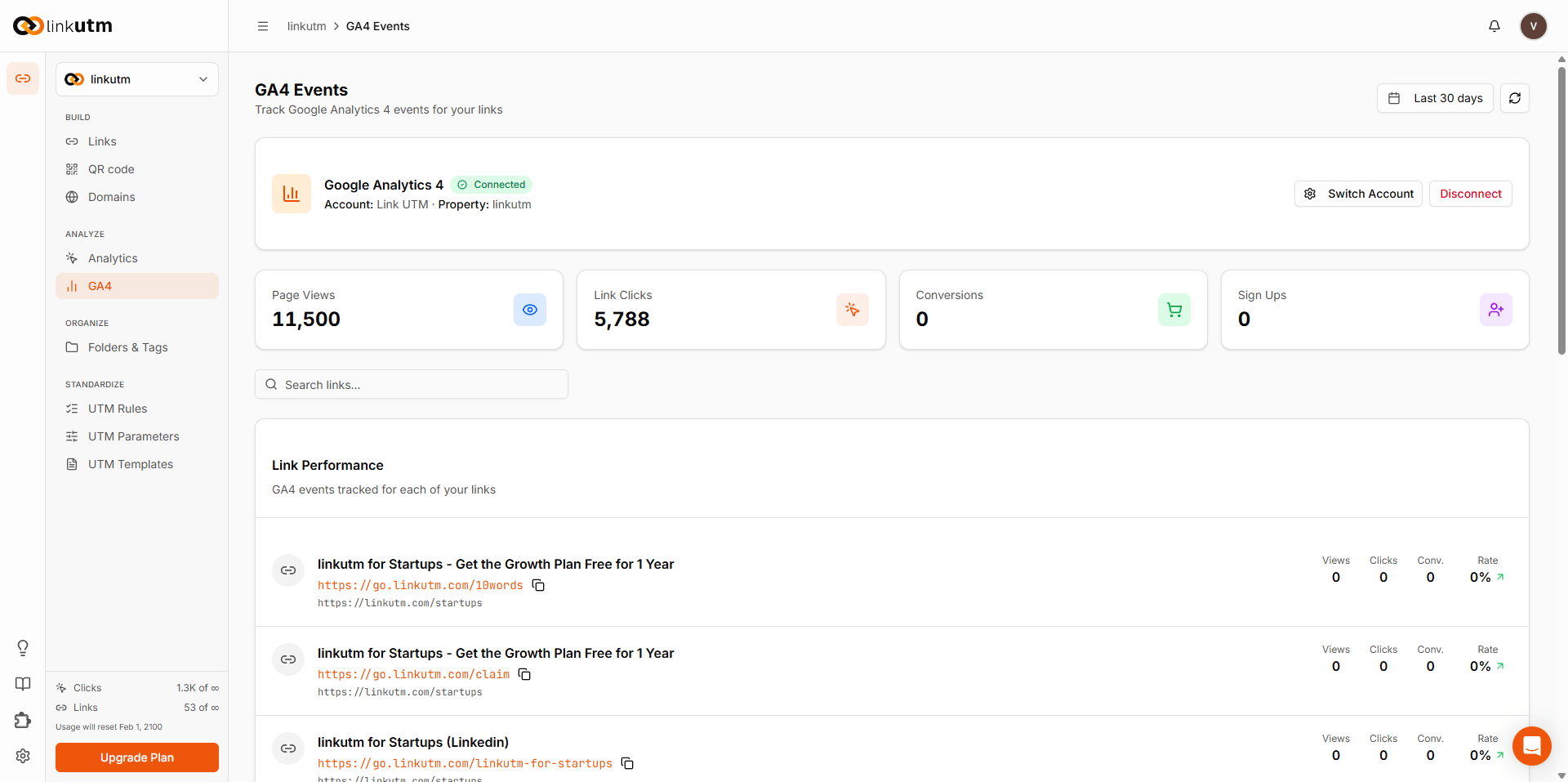
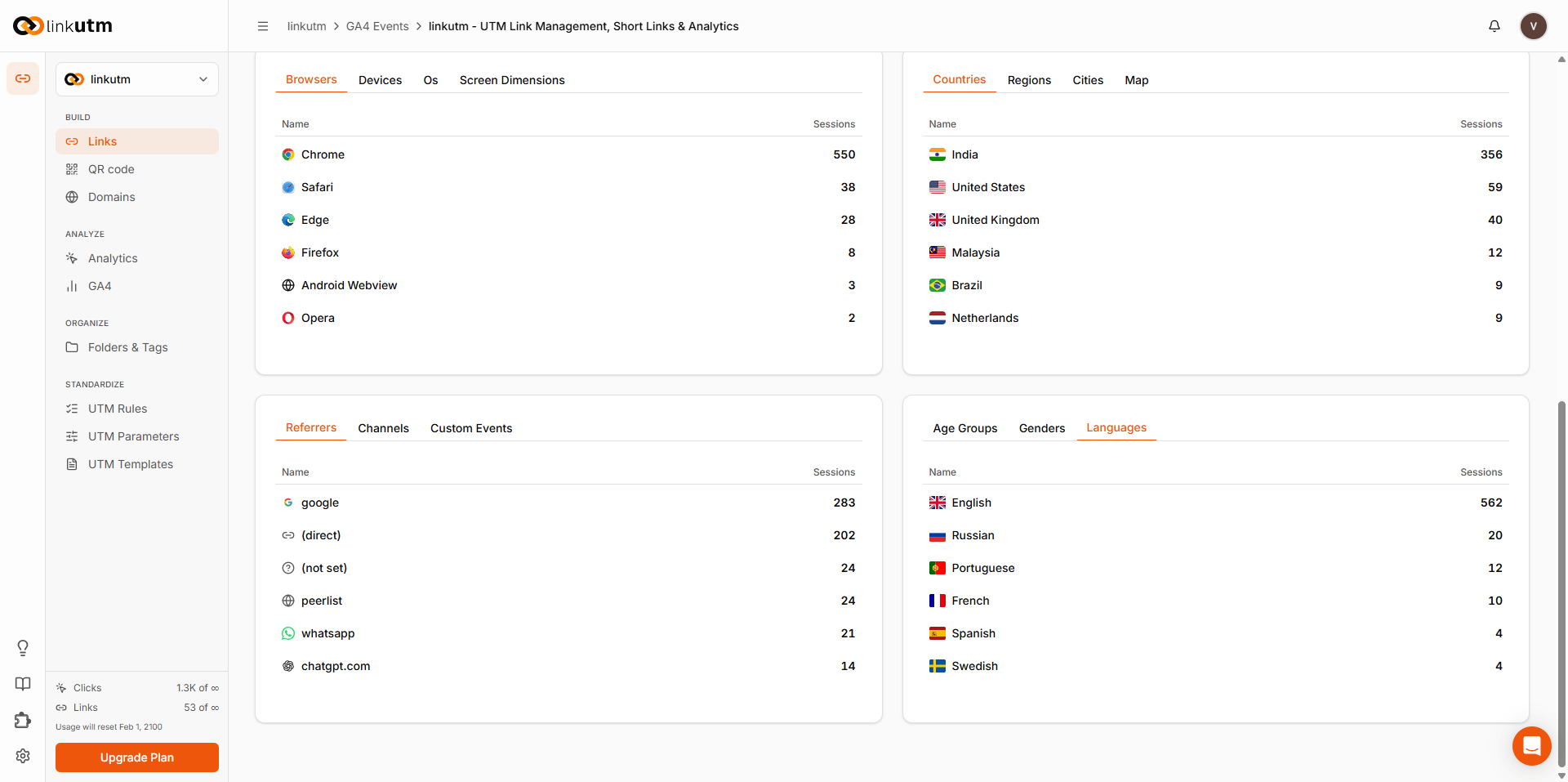
Per-link GA4 analytics
Click any link in the GA4 Events dashboard to see its individual event breakdown, views, clicks, conversions, and event timeline.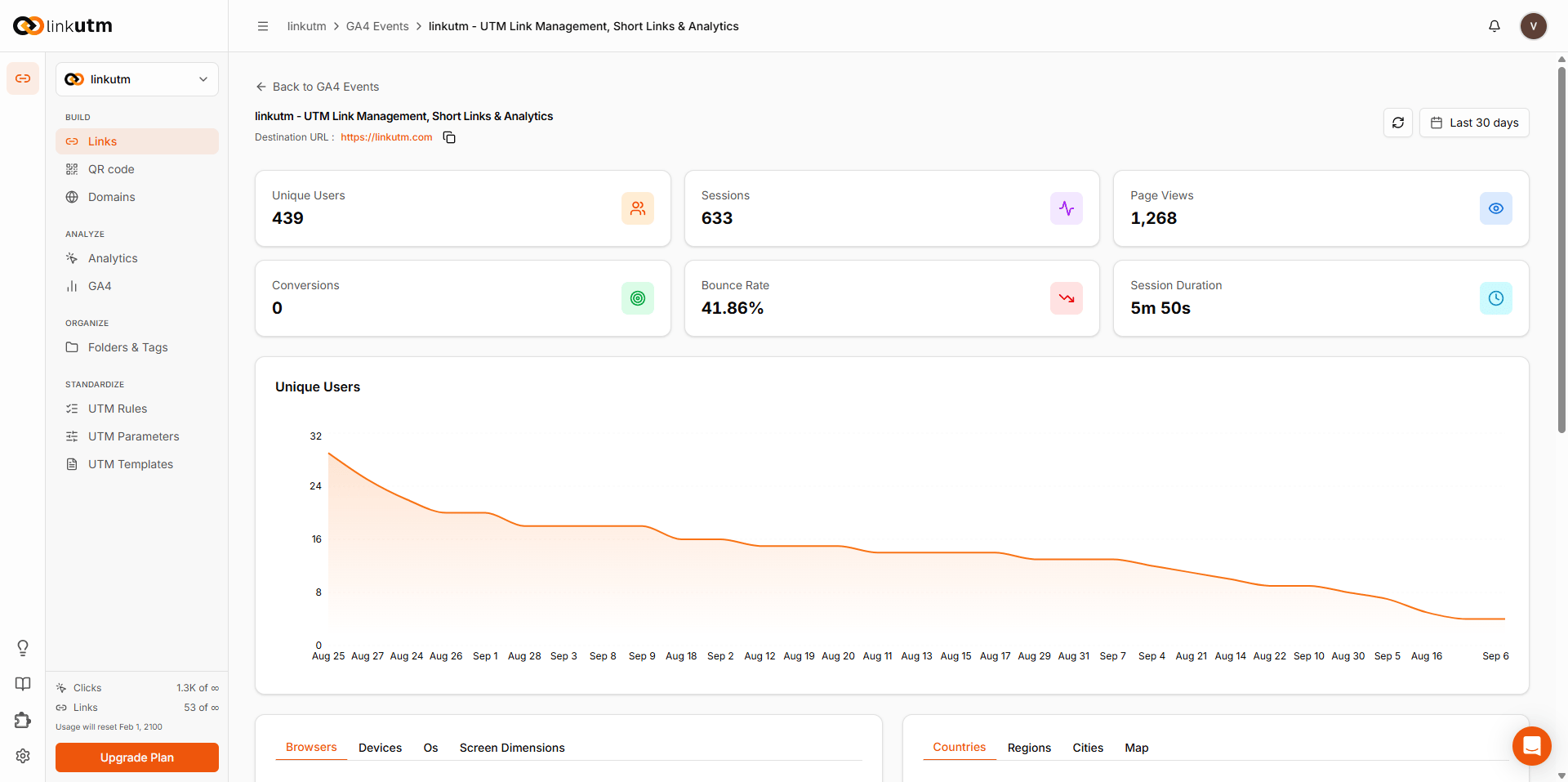
How GA4 reads UTMs
GA4 captures five UTM parameters automatically on session start:
Source, medium, and campaign appear in the built-in Traffic Acquisition report out of the box. Content and term require a custom dimension to surface in standard reports.
Channel grouping
GA4 usesutm_medium to place sessions into channel groups in the Default Channel Grouping report. If your medium values don’t match GA4’s rules, sessions land in “Unassigned.”
The UTM naming convention page lists the recommended medium vocab that maps cleanly to GA4’s default channels.
Set up custom dimensions for utm_content and utm_term
GA4 does not exposeutm_content and utm_term in standard reports unless you register them as custom dimensions.
1
Open GA4 Admin
Go to Admin → Data display → Custom definitions.
2
Create dimension for utm_content
Click Create custom dimension and fill in:
- Dimension name:
Manual Ad Content - Scope: Session
- Event parameter:
manual_content
3
Create dimension for utm_term
Click Create custom dimension again:
- Dimension name:
Manual Term - Scope: Session
- Event parameter:
manual_term
4
Wait for data
Custom dimensions only collect data going forward. Allow 24-48 hours before they appear in reports. Historical sessions are not backfilled.
5
Use in Explore
In GA4 Explore, add Manual Ad Content or Manual Term as a dimension. These are now available across any exploration report.
Verify attribution is working
Use GA4 DebugView to confirm UTMs are being captured before you run a campaign.1
Install GA4 DebugView extension
Install the Google Analytics Debugger Chrome extension and enable it.
2
Click a test linkutm link
Create a test link in linkutm with known UTM values. Click it.
3
Check DebugView
In GA4 Admin → DebugView, look for the
session_start event. Expand it and confirm:traffic_source.sourcematches yourutm_sourcetraffic_source.mediummatches yourutm_mediumtraffic_source.campaignmatches yourutm_campaign
4
Verify custom dimensions
Look for
manual_content and manual_term parameters on the same event if you set those UTMs on the test link.Real-world example
A marketing team runs three links for a Q2 campaign and wants to see clean channel splits in GA4.campaign = q2-pricing-relaunch to see all three channels side by side. In Explore, add Manual Ad Content to compare headline-a vs hero-cta vs cta-book-demo on conversions.
Common mistakes
Sessions showing as Direct instead of the expected channel
Sessions showing as Direct instead of the expected channel
Three causes: the UTMs were stripped from the URL before GA4 loaded (check for URL rewrites or redirects that drop query params), the visitor’s browser blocked the GA4 tag, or cookie consent blocked the tag from firing. Use DebugView to rule out the first cause.
Source showing as the short link domain instead of utm_source
Source showing as the short link domain instead of utm_source
If a visitor clicks
go.yourdomain.com/xyz and GA4 fires on the destination page, GA4 may record the short link domain as the referrer instead of reading the UTM. This happens when linkutm’s redirect passes the referrer header. Fix: add your short link domain to the Referral exclusion list in GA4 Admin → Data streams → Configure tag settings → List unwanted referrals.utm_campaign shows as (not set) in reports
utm_campaign shows as (not set) in reports
The UTM was missing from the link or was stripped during redirect. Check the actual destination URL in browser dev tools → Network tab → look at the final URL after redirect to confirm
utm_campaign is present.Channel grouping shows Unassigned for paid traffic
Channel grouping shows Unassigned for paid traffic
Your
utm_medium value doesn’t match GA4’s channel rules. paid-social and cpc are correct. PaidSocial, paid_social, or social are not. See the channel grouping table above.utm_content not appearing in Explore
utm_content not appearing in Explore
The custom dimension for
manual_content has not been created yet, or was created after the sessions you’re looking at (no backfill). Create the dimension and wait 24-48 hours for new data.Edge cases
Internal traffic. If you or your team click linkutm links during testing, those sessions will appear in GA4. Define an internal traffic rule in GA4 Admin → Data streams → Configure tag settings → Define internal traffic to exclude your IP ranges.
Cross-domain tracking. If your destination page is on a different domain from your short link (e.g.
go.yourdomain.com redirects to app.yourproduct.com), GA4 may count the visit as a new session and lose the UTM. Add the short link domain to the cross-domain list in GA4 Admin → Data streams → Configure tag settings → Configure your domains.UTM parameters persist for the session only. GA4 attributes UTMs to the session in which the user first arrived. If the same user returns later without UTMs, GA4 does not re-attribute that session. This is standard GA4 behavior, not a linkutm issue.